- Conservative Fix
- Posts
- Gorsuch Sounds Alarm on Patriotic Education
Gorsuch Sounds Alarm on Patriotic Education
A Supreme Court Justice warns of civic illiteracy and historical ignorance.
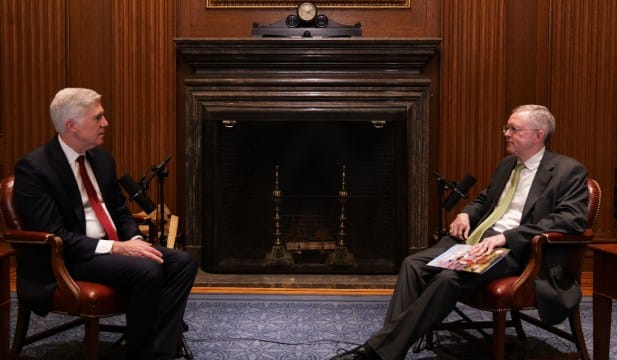
Gorsuch Warns of Patriotic-Education Crisis
Supreme Court Justice Neil Gorsuch recently delivered a powerful message concerning the state of civic education in America, highlighting a growing "patriotic-education gap" that threatens the very foundations of our constitutional republic. Speaking at a Hillsdale College event, Justice Gorsuch articulated his concerns about the lack of understanding of American history, civics, and the principles that underpin our government. His remarks served as a stark reminder of the importance of cultivating informed and engaged citizens who appreciate the unique blessings of liberty we enjoy.
Justice Gorsuch didn't mince words, emphasizing the need for a renewed focus on teaching the core tenets of American exceptionalism. He stated, "How many Americans today know even the basic mechanics of their government? How many understand the enduring principles that unite us? How many appreciate the origins of those principles in the long struggle for freedom?"
The Diminishing Knowledge of American Principles
The Justice's concerns are not unfounded. Numerous studies and surveys paint a troubling picture of civic illiteracy among Americans, particularly younger generations. A 2023 survey by the Annenberg Public Policy Center found that only 47% of Americans could name all three branches of government. Furthermore, a study by the Woodrow Wilson National Fellowship Foundation revealed that only one in three Americans could pass a basic U.S. citizenship test. These statistics underscore a significant deficiency in civic knowledge, raising serious questions about the future of self-governance.
This lack of understanding extends beyond mere facts and figures. It encompasses a deeper appreciation for the values and ideals that have shaped our nation. The principles of individual liberty, limited government, and the rule of law, once considered cornerstones of American identity, are increasingly misunderstood or even dismissed by some segments of society. This erosion of civic knowledge and appreciation poses a grave threat to the preservation of our constitutional republic.
Gorsuch on the Enduring Relevance of 1776
Justice Gorsuch specifically highlighted the importance of understanding the year 1776, the year of the Declaration of Independence. He emphasized that the principles enshrined in that document, and the subsequent struggle for independence, remain profoundly relevant to the challenges we face today. He asserted that understanding the historical context and philosophical underpinnings of the American Revolution is essential for preserving our freedoms and safeguarding our constitutional order. As Gorsuch noted, “We have to remember 1776.”
The Declaration of Independence, with its assertion of unalienable rights and the pursuit of happiness, represents a radical departure from the prevailing political philosophies of the time. It established the principle that government derives its just powers from the consent of the governed, a revolutionary idea that continues to inspire movements for freedom and self-determination around the world. Understanding the significance of 1776 requires grappling with the complex history of the American Revolution, including the sacrifices made by those who fought for independence and the challenges of building a new nation founded on principles of liberty and equality.
The Role of Education in Cultivating Patriotism
Justice Gorsuch's remarks implicitly call for a renewed emphasis on civic education in schools and universities. He suggests that educators have a responsibility to instill in students a deep understanding of American history, civics, and the principles of constitutionalism. This includes teaching the successes and failures of our nation, the struggles and triumphs of those who fought for justice and equality, and the ongoing efforts to perfect our union. However, the approach to teaching these subjects is key.
It is crucial that civic education be approached in a balanced and objective manner, avoiding the pitfalls of ideological indoctrination. Students should be encouraged to think critically about the challenges facing our nation and to engage in respectful dialogue with those who hold different perspectives. The goal should be to cultivate informed and engaged citizens who are capable of participating in the democratic process and contributing to the common good. For example, a 2021 report by the National Assessment of Educational Progress (NAEP) showed that only 24% of eighth-graders scored at or above proficient in civics. This demonstrates a clear need for improved civics education in our schools.
Challenges to Patriotic Education
One of the challenges to patriotic education is the increasing politicization of history. Some argue that traditional accounts of American history have glossed over the darker aspects of our past, such as slavery and discrimination, and that a more critical and nuanced approach is needed. Others worry that an excessive focus on these issues risks undermining national pride and fostering a sense of guilt and shame. Finding a balance between acknowledging the flaws in our past and celebrating the achievements of our nation is a delicate but essential task.
Another challenge is the rise of historical revisionism, which seeks to rewrite history to fit a particular political agenda. This can involve distorting facts, omitting relevant information, or promoting biased interpretations of events. It is important to be vigilant against such efforts and to ensure that students are exposed to accurate and reliable sources of information. Furthermore, the decline in parental involvement in education contributes to the problem. A 2019 study by the Pew Research Center found that only 33% of parents regularly discuss civic issues with their children. This lack of engagement at home further exacerbates the civic knowledge gap.
The Importance of Civic Engagement
Justice Gorsuch's concerns extend beyond the classroom. He emphasizes the importance of civic engagement at all levels of society. He encourages citizens to participate in the democratic process, to hold their elected officials accountable, and to engage in respectful dialogue with those who hold different views. He believes that a healthy democracy requires active and informed citizens who are willing to defend the principles of liberty and justice for all.
Civic engagement can take many forms, from voting and volunteering to writing letters to elected officials and participating in peaceful protests. It is essential that citizens understand their rights and responsibilities and that they are willing to exercise them. A 2022 report by the U.S. Elections Project found that voter turnout in the midterm elections was the highest it has been in decades, suggesting a growing interest in civic participation among Americans. However, this increased engagement must be sustained and channeled effectively to address the challenges facing our nation.
Gorsuch's Vision for the Future
Justice Gorsuch's remarks offer a vision for a future in which all Americans are well-versed in the principles of their government and actively engaged in the democratic process. He believes that by cultivating a deeper understanding of our history, civics, and constitutionalism, we can strengthen our nation and ensure that the blessings of liberty are preserved for future generations. This requires a renewed commitment to patriotic education, both in schools and in our communities. Justice Gorsuch has also expressed his appreciation for his colleagues on the Supreme Court, highlighting the collegial atmosphere and the shared commitment to upholding the Constitution.
The Supreme Court and Constitutional Interpretation
While Justice Gorsuch did not delve deeply into specific legal doctrines, his emphasis on originalism provides insight into his approach to constitutional interpretation. Originalism, a legal philosophy that emphasizes the original meaning of the Constitution, is a cornerstone of his jurisprudence. He believes that judges should strive to interpret the Constitution as it was understood by those who drafted and ratified it, rather than imposing their own subjective values or policy preferences. This approach is often contrasted with living constitutionalism, which holds that the Constitution should be interpreted in light of contemporary values and social conditions. The debate between these two approaches is central to many of the most contentious legal and political issues of our time.
Justice Gorsuch's commitment to originalism reflects a broader conservative legal philosophy that emphasizes judicial restraint and the separation of powers. He believes that judges should defer to the elected branches of government whenever possible and that they should avoid creating new rights or remedies that are not explicitly grounded in the Constitution. This philosophy has been influential in shaping the jurisprudence of the Supreme Court in recent years, particularly with the appointment of other conservative justices such as Amy Coney Barrett and Brett Kavanaugh.
Moving Forward: A Call to Action
Justice Gorsuch's warning about the patriotic-education gap serves as a call to action for all Americans. It is a reminder that the preservation of our constitutional republic depends on the cultivation of informed and engaged citizens who understand and appreciate the principles of liberty and self-government. By renewing our commitment to civic education, promoting civic engagement, and upholding the rule of law, we can ensure that the American experiment in freedom continues to thrive for generations to come. This is a challenge that requires the collective effort of educators, parents, policymakers, and all citizens who cherish the blessings of liberty.