- Conservative Fix
- Posts
- F-15 Crash Investigation Focuses on Pilot Error
F-15 Crash Investigation Focuses on Pilot Error
Search concludes for second crewmember after Eagle mishap raises questions about training and maintenance protocols.
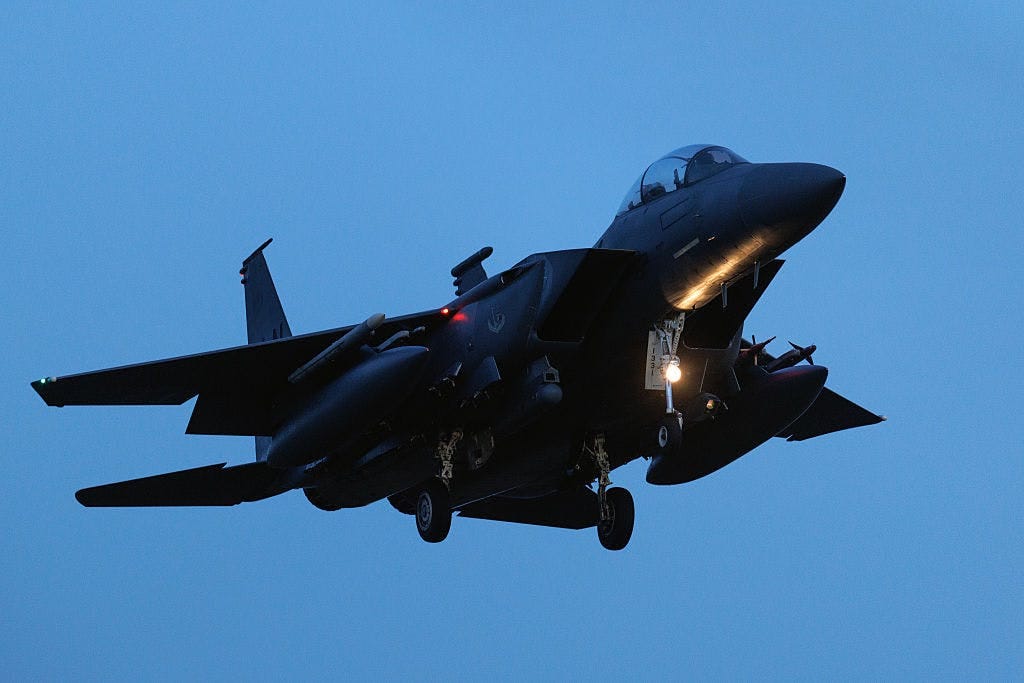
F-15E Crash: Search Ends, Investigation Begins
The United States Air Force is investigating the circumstances surrounding the recent crash of an F-15E Strike Eagle fighter jet. The incident, which occurred in a training area, resulted in the loss of one airman and the rescue of another. The focus now shifts to determining the root cause of the accident and preventing future tragedies.
Search and rescue teams worked tirelessly following the crash, combing the area for the missing crewmember. After an extensive search, authorities confirmed the recovery of the second airman, tragically deceased. The Air Force has expressed its deepest condolences to the family and friends of the fallen airman, pledging full support during this difficult time. The name of the airman is being withheld pending notification of next of kin, in accordance with military protocol.
The rescued crewmember is reportedly in stable condition and is receiving medical care. They will likely play a crucial role in the investigation, providing firsthand accounts of the events leading up to the crash.
The F-15E Strike Eagle: A Workhorse of the Air Force
The F-15E Strike Eagle is a twin-engine, all-weather, multirole fighter designed for air-to-air and air-to-ground missions. It has been a mainstay of the U.S. Air Force since the late 1980s and has seen extensive combat service in various conflicts, including the Gulf War, Operation Iraqi Freedom, and Operation Enduring Freedom. The F-15E is known for its speed, maneuverability, and advanced avionics, making it a formidable asset in modern warfare. The aircraft boasts a combat radius of approximately 800 nautical miles and can carry a wide array of air-to-air and air-to-ground ordnance.
The specific F-15E involved in the crash was assigned to a training squadron. These squadrons are responsible for preparing new pilots and weapon systems officers for combat duty. Training missions often involve complex maneuvers and simulated combat scenarios, which inherently carry a degree of risk. However, safety protocols are rigorously enforced to minimize the possibility of accidents.
Investigation Focus: Pilot Error, Maintenance, and Training
The Air Force has launched a thorough investigation to determine the cause of the F-15E crash. The investigation will likely examine several factors, including pilot error, mechanical failure, maintenance records, and training procedures. A team of experts, including experienced pilots, maintenance personnel, and safety investigators, will meticulously analyze the available evidence to identify any contributing factors.
One area of focus will undoubtedly be the experience level of the crew. While all Air Force pilots undergo extensive training, the amount of flight time and combat experience can vary significantly. Investigators will examine the crew's flight records, training evaluations, and any prior incidents or performance issues. It's also crucial to consider the possibility of spatial disorientation, a phenomenon that can affect even the most experienced pilots, especially during high-G maneuvers or in adverse weather conditions. In 2023, the Air Force Safety Center reported that spatial disorientation contributed to 7% of Class A mishaps (those resulting in fatalities or significant damage).
Maintenance records will also be scrutinized to identify any potential mechanical issues that may have contributed to the crash. The F-15E is a complex machine, and regular maintenance is essential to ensure its safe operation. Investigators will examine the aircraft's maintenance history, looking for any recurring problems, deferred maintenance items, or deviations from standard procedures. Furthermore, they will assess the quality of the maintenance performed and whether any shortcuts were taken due to time constraints or resource limitations. The average age of the F-15E fleet is over 30 years, raising concerns about the potential for age-related mechanical failures. A 2022 Government Accountability Office (GAO) report highlighted the increasing maintenance costs associated with aging military aircraft, including the F-15E.
Training procedures will also come under review. Investigators will examine the training syllabus, flight briefings, and debriefings to determine whether the crew was adequately prepared for the mission. They will also assess the quality of the training and whether any changes are needed to improve safety. The Air Force has implemented several initiatives in recent years to enhance pilot training, including the use of advanced simulators and virtual reality technology. However, it is essential to ensure that these initiatives are effectively implemented and that pilots receive the necessary skills and knowledge to operate the F-15E safely.
Human factors will also be considered. This includes assessing the crew's physical and mental state at the time of the flight, as well as any external stressors that may have affected their performance. Investigators will look into factors such as fatigue, stress, and personal issues to determine whether they played a role in the crash. The Air Force has programs in place to address these issues, but it is crucial to ensure that they are effective and that airmen feel comfortable seeking help when needed.
Previous F-15 Crashes and Safety Concerns
While the F-15E Strike Eagle has a strong safety record overall, there have been previous crashes involving the aircraft. Each incident is thoroughly investigated to identify the cause and implement corrective actions. These investigations often lead to changes in training procedures, maintenance protocols, or aircraft design.
In 2007, the entire F-15 fleet was temporarily grounded after the in-flight breakup of an F-15C. The investigation revealed a structural flaw in the aircraft's longerons, which are critical load-bearing components. The grounding lasted for several weeks while the Air Force inspected all F-15s for similar flaws and implemented repairs. This incident highlighted the importance of regular inspections and the need to address potential structural issues before they lead to catastrophic failures. The 2007 grounding cost an estimated $30 million in inspection and repair costs.
Another F-15E crashed in 2014 during a training mission. The investigation determined that the crash was caused by a combination of pilot error and mechanical failure. The pilot made a series of mistakes during a low-altitude maneuver, and a faulty engine component contributed to the loss of control. This incident underscored the importance of both pilot proficiency and proper maintenance.
The Future of the F-15E and Air Force Safety
The F-15E Strike Eagle remains a vital asset for the U.S. Air Force, and the service plans to continue operating the aircraft for many years to come. However, the recent crash raises questions about the long-term viability of the F-15E fleet, given its age and the increasing cost of maintenance. The Air Force is currently developing and fielding new fighter aircraft, such as the F-35 Lightning II, which are intended to replace older platforms like the F-15E.
The Air Force is committed to maintaining the highest standards of safety in all its operations. The service has implemented numerous programs and initiatives to reduce the risk of accidents, including enhanced pilot training, improved maintenance procedures, and advanced safety technology. The Air Force also emphasizes a culture of safety, encouraging airmen to report potential hazards and to learn from past mistakes.
The investigation into the F-15E crash will undoubtedly lead to further improvements in Air Force safety practices. The lessons learned from this tragedy will help to prevent future accidents and to ensure the safety of airmen for years to come. As General Mark Kelly, commander of Air Combat Command, stated last year, "Our airmen's safety is paramount. We continuously evaluate our training and maintenance programs to mitigate risks and ensure our forces are prepared for any mission."
The loss of an airman is a profound tragedy, and the Air Force is committed to honoring their memory by ensuring that such incidents are thoroughly investigated and that appropriate measures are taken to prevent them from happening again. The F-15E, while a capable aircraft, is showing its age. The Air Force is walking a tightrope balancing operational needs with the increasing risks associated with older platforms, a challenge that will only intensify in the coming years.